India’s Four Chip Fabs Going Live in 2026: Can 75% Local Production Become Reality?
India’s semiconductor manufacturing push is becoming operational, but the headline combines two claims that need separating. The four facilities originally expected to enter commercial production in 2026 were not four equivalent wafer fabs. And the government’s 70–75% ambition concerns the capability to design and manufacture chips for domestic applications—not proof that three-quarters of India’s semiconductor spending will soon become local factory revenue.

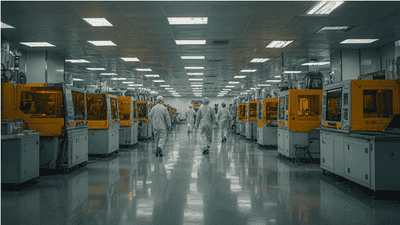
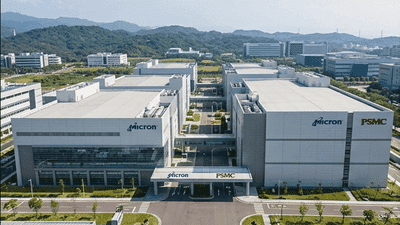
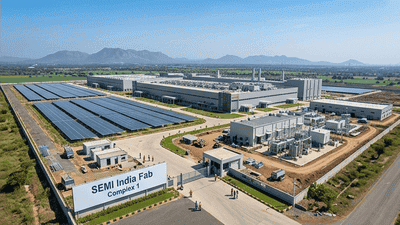
Early announcements named Micron, CG Semi, Kaynes, and Tata’s Assam operation among the expected production milestones. These are principally assembly, packaging, and testing projects. Officials separately identified Tata’s Dholera wafer-fabrication plant as a 2028 milestone. By October 6, 2026, the government reported that five semiconductor plants had commenced commercial production, updating the earlier four-unit expectation without establishing that five full-scale wafer fabs were operating.
That is meaningful progress. It is also a different achievement from comprehensive semiconductor self-sufficiency.
The financial question is whether India can turn those first production milestones into competitive capacity while managing interest rates, currency exposure, credit requirements, and infrastructure costs.
The First Reality Check: Packaging Is Manufacturing, but Not Fabrication
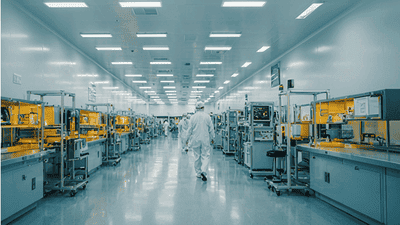
A wafer fab creates semiconductor devices through highly controlled processing steps. Assembly and testing facilities take manufactured dies and turn them into qualified, packaged products.
Both are important. They require different equipment, skills, capital, and operating economics.
A packaging plant can create domestic jobs, supplier relationships, exports, and manufacturing expertise while still relying on imported dies.
That is not a failure. It is a specific position in the value chain.
The problem arises when packaged-chip output is described as though the entire chip was fabricated domestically. That overstates import substitution and obscures the next investment requirement.
India’s early manufacturing progress should therefore be measured by the actual activity performed locally rather than by treating every facility as a fab.
What Does the 75% Ambition Measure?

Official material states that India aims to develop the capability to design and manufacture chips required for nearly 70–75% of domestic applications by 2029.
“Applications” is not the same denominator as shipment volume, market value, or domestic value added.
A broad set of everyday products may use chips that can be served by mature processes. A smaller set of advanced computing applications can account for substantial spending while requiring technologies not yet produced locally.
There is another distinction: possessing the capability to serve an application does not mean supplying all its demand.
Capacity, qualification, pricing, and customer adoption determine actual production.
The ambition can therefore be understood as expanding technological coverage. It should not be converted into a precise local-content percentage without a clearly defined measurement framework.
A Second Official Framework Suggests a More Gradual Path
A June 2026 NITI Aayog report proposed targeting chip self-sufficiency equivalent to 15–25% of local demand by 2030 and 35–50% by 2035. It separately proposed higher goals for retaining value across the semiconductor supply chain.
Those figures should not simply be placed beside 75% and labeled contradictory.
They measure different things: application capability, supply of domestic demand, and value retention.
The distinction is central to industrial strategy.
India could design a chip locally, manufacture it overseas, and package it domestically. That creates Indian value without complete local production.
Conversely, a domestically fabricated product may use imported equipment, materials, and intellectual property.
Self-sufficiency is therefore a spectrum. The most useful policy scorecard explains which part of that spectrum each target addresses.
Interest Rates Put a Price on the Ramp

Semiconductor projects commit money before they generate dependable commercial returns.
Buildings, tools, training, process development, and working capital require funding ahead of mature production.
Higher interest rates increase borrowing costs and the return equity investors require. They also reduce the present value of profits expected years ahead.
Government support can reduce the initial burden, but it does not make private capital economically free.
This matters differently across projects. A packaging operation may reach revenue sooner than a complex new wafer fab, while still facing its own qualification and utilization challenges.
The investment test is not whether a project receives approval. It is whether its expected cash generation supports the full capital commitment under realistic ramp-up assumptions.
Credit Determines Whether Construction Becomes Production
Announced investment is not always the same as available funding.
Lenders assess sponsor strength, customer visibility, technology partners, collateral, and the ability to absorb delays.
A project with a strong sponsor and qualified customer commitments can have a different financing profile from a new entrant relying on anticipated orders.
Funding must also cover the transition into operation.
Materials, inventories, engineering, and receivables can consume cash even after a plant starts producing. Early commercial activity does not necessarily mean positive free cash flow.
India’s financing challenge is therefore broader than paying for facilities. It includes supporting companies through the period when output, acceptance, and cash collection remain uneven.
That period is where a credible project can become financially fragile.
The Rupee Complicates the Localization Story
A weaker rupee can improve the international competitiveness of domestic costs and increase the local-currency value of export receipts.
It can also raise the cost of imported equipment, dies, materials, and services priced in foreign currencies.
That opposing effect is particularly important during India’s early manufacturing phase.
A plant may add local packaging value while continuing to import a substantial part of its inputs. Currency depreciation can increase the input bill before export benefits arrive.
The net result depends on contract currencies, hedging, payment schedules, and customer pricing.
Localization should therefore be evaluated through actual value added rather than the location of final assembly alone.
A factory in India does not automatically eliminate foreign-currency exposure.
Import Substitution May Initially Require More Imports
Building a semiconductor industry can increase imports before it reduces them.
Equipment and specialized inputs are needed to establish production. Early operating facilities may import dies or other components while domestic capabilities develop.
This can create a temporary tension between the investment program and expectations for immediate improvement in the trade balance.
The relevant question is whether those imports build productive capacity that subsequently creates exports or replaces selected purchases.
That outcome requires competitive costs and customer demand.
Importing expensive tools without achieving useful utilization does not generate the intended economic benefit.
The trade effect should therefore be assessed over the investment’s operating life, not judged solely by the first construction year or the first shipment announcement.
Power and Water Are Financial Variables
Semiconductor facilities depend on reliable utilities and supporting infrastructure.
Electricity, water treatment, chemicals, gases, and logistics influence both cost and readiness.
A higher utility price affects margins. An unavailable connection can delay production altogether.
That distinction matters to the financing model because a delay extends the period between expenditure and revenue.
Construction materials and electrical equipment also connect the program to commodity markets. Their availability can be as important as their price.
Specialized semiconductor inputs add qualification requirements that ordinary bulk commodities do not capture.
For India, industrial competitiveness therefore depends on a complete operating environment. A subsidy can help purchase equipment; it cannot independently make every supporting system reliable.
Mature Nodes Can Be a Rational Starting Point
Leadership in semiconductors is often discussed through the smallest process node. That is too narrow for India’s initial opportunity.
Power management, analog functions, microcontrollers, sensors, and other applications can create meaningful demand outside leading-edge logic.
NITI Aayog’s report recommended building strength in mature and compound-semiconductor technologies, including selected logic and mixed-signal processes serving automotive, industrial, and power applications.
The attraction is a closer match between accessible manufacturing capabilities and domestic requirements.
But mature does not mean easy or automatically profitable.
Customers still require reliable performance and qualification. Producers still compete on cost, quality, and delivery.
The strategy works when it targets specific products and customers—not when it assumes a familiar process node guarantees a ready market.
Domestic Demand Is an Anchor, Not a Purchase Order
India’s growing electronics market gives manufacturers a substantial potential customer base.
Potential demand, however, is not committed procurement.
Customers choose chips according to design requirements, reliability, price, availability, and established supplier relationships.
A locally produced component must satisfy those conditions. Geographic proximity may help logistics or resilience, but it does not remove technical requirements.
This is especially important where devices are manufactured in India using globally standardized designs.
The customer may not be able to switch a component simply because a domestic alternative appears.
Industrial policy can support supply development. Sustainable demand requires products that customers can qualify and economically use.
The Design Base Can Expand Value Retention
Manufacturing is only one route to increasing India’s participation in semiconductors.
Design, intellectual property, packaging, testing, and specialized materials can retain value even when some fabrication occurs overseas.
This helps explain why the next phase of policy places attention on the broader ecosystem rather than facilities alone.
Officials have described plans to deepen domestic capabilities in equipment, materials, and design alongside production.
The approach can reduce the risk of equating industrial success with factory count.
However, each capability needs its own commercial test. Design talent must become viable products or services. Materials must be qualified. Equipment must work consistently.
A complete ecosystem cannot be declared into existence. It develops through customers, learning, and repeat transactions.
Three Paths Toward the Localization Ambition
In a strong-execution scenario, packaging operations achieve competitive utilization, the wafer-fab program advances, and domestic suppliers develop around them. Application coverage expands alongside measurable local value.
In a gradual-development scenario, packaging grows faster than fabrication. India increases participation meaningfully while remaining dependent on imported dies and advanced products.
In a weaker scenario, funding, qualification, or infrastructure delays keep facilities below useful utilization. Announced capacity advances more quickly than commercial competitiveness.
These are scenarios, not forecasts.
They demonstrate why a 75% headline cannot settle the outcome. The path depends on which capability is measured and whether customers adopt the resulting products.
A Better Scorecard Than Plant Count
The central requirement is conversion: converting policy support into reliable production, then converting production into customer value.
A useful scorecard would track:
- Wafer fabrication separately from assembly and testing.
- Qualified output rather than announced capacity.
- Actual utilization and repeat customer orders.
- Local value added rather than shipment value alone.
- Equipment and material import requirements.
- Funding resilience and cash conversion.
- Infrastructure readiness and production reliability.
These measures explain the quality of progress.
They also allow the program to earn credit for real achievements without presenting early-stage manufacturing as comprehensive independence.
Can 75% Become Reality?
India can plausibly broaden its ability to serve a large share of domestic semiconductor applications. That is not the same as proving that 75% of semiconductor value or physical supply will be produced locally by 2029.
The 2026 manufacturing milestones are important, and official reporting now extends beyond the original four-unit expectation. But packaging progress and wafer-fabrication progress remain distinct.
Rates influence investment hurdles, credit supports the ramp, the rupee changes imported costs, and utilities determine operational readiness.
The strongest outcome will be measured in competitive products and retained value—not in a generous interpretation of the word “fab.” India’s semiconductor opportunity is substantial. Precision about the milestones makes that opportunity more credible, not less.